Imagine being deep in the wilderness with no fishing gear. No tackle box, no metal hooks, just the clothes on your back and the trees around you. Your stomach growls. A fish breaks the surface nearby. What now? The answer lies in one of humanity’s oldest survival skills: how to make a fishing hook out of wood.
This guide covers exactly how to make a fishing hook out of wood, from selecting the right hardwood to carving, binding, baiting, and fishing with it successfully. You will discover three proven designs, plus tips on hardening wood, securing spikes, and the critical delayed retrieval technique that makes these primitive hooks work.
Choose the Right Wood and Materials
The success of a wooden fishing hook starts with material selection. Not all wood works. Soft, splinter-prone types like pine will fail under pressure. You need dense, fine-grained hardwood that resists splitting and holds a point.
Best Woods for Fishing Hooks
The following hardwoods provide the strength and workability needed for reliable hooks.
Oak delivers excellent durability and widespread availability across most regions.
Apple wood offers fine grain that carves smoothly and resists warping over time.
Hawthorn provides naturally hard material, making it ideal for thorn-based hook designs.
Black thorn delivers extreme toughness for spike construction.
Maple features a smooth texture excellent for carving precise hook shapes.
Look for straight-grained, knot-free sections about one-quarter to one-half inch in diameter and one to four inches long. Always use dry or seasoned wood. Green wood softens in water and cracks as it dries.
Natural vs. Scavenged Additions
While pure wood hooks work, combining materials increases effectiveness.
Thorns from blackthorn and hawthorn provide pre-sharpened, durable piercing tips.
Bone shards offer superior penetration when sharpened from animal remains.
Bamboo splinters are naturally rigid and sharp when split properly.
Animal teeth and claws served as piercing elements in historical designs.
Scavenged metal items like nails, safety pins, and ring pulls provide more reliable options when available.
Cordage That Will Not Fail
Your hook is only as strong as its weakest link, and that is often the cordage. Avoid weak plant fibers unless properly twisted. Prioritize sinew from animal tendon, which provides high tensile strength and shrinks when dry to tighten wraps. Nettle or hemp fiber delivers strong results when braided. Inner bark from cedar or basswood offers flexibility and durability when processed. Paracord or fishing line, when available, provides the best reliability. Test any cord by pulling hard before use. If it frays or snaps, it will not hold a fish.
Build a Single-Point Gorge Hook

This is the fastest, simplest wooden hook design, perfect for emergency survival situations.
What It Is and How It Works
A single-point gorge hook is a sharpened spike tied at one end to the line. When baited and swallowed, pulling the line causes the spike to rotate sideways in the fish is throat, lodging it firmly. It will not fool cautious fish, but for hungry panfish or perch, it works effectively.
Step-by-Step Construction
Follow these steps to build a functional single-point gorge hook.
Select a spike using a one to two inch blackthorn or hawthorn thorn, or carve a hardwood splinter to a fine point.
Sharpen the tip using a knife or even a rock to create a conical, needle-like point. A pencil sharpener works well for small wooden spikes.
Tie the line by securely binding the fishing line to the blunt end of the spike using a double overhand knot or wraps.
Bait the hook by inserting the spike into a worm or grub so it lies parallel to the bait is length.
Cast and wait, letting the fish swallow fully before retrieving.
Position the line so it forms a V shape with the spike. This ensures rotation when pulled.
Target Fish and Limitations
This design works best for panfish, perch, and small trout up to two pounds. Advantages include quick construction, minimal tools required, and high success with proper technique. Drawbacks include no reusability, limited strength, and the requirement for full ingestion by the fish.
Craft a Double-Point Gorge Hook
For better retention and self-setting action, upgrade to a double-point toggle hook.
Why It Is More Effective
This design uses a spike sharpened at both ends, tied in the middle. When the fish swallows it and you pull the line, the hook rotates 90 degrees, wedging crosswise in the throat. No hookset timing is needed. Simply wait and retrieve.
Materials Needed
Gather a two-inch piece of hardwood or bone, a knife or chisel, and strong cordage.
How to Make It
Shape the spike by carving a straight rod and sharpening both ends to sharp points.
Tie the line by wrapping cord tightly around the center of the spike, creating the pivot point.
Place bait by embedding the hook inside bait so it runs parallel to the fishing line.
Deploy by casting, letting the fish swallow, then retrieving slowly.
When pulled, the spike should rotate from inline to perpendicular, like a toggle bolt. This design catches bluegill, small bass, and catfish up to five pounds. Bone versions outperform wood due to density and sharpness.
Build a Composite Wooden Fish Hook
This is the most effective wooden hook design, mimicking a modern J-hook using natural materials.
Why This Design Wins
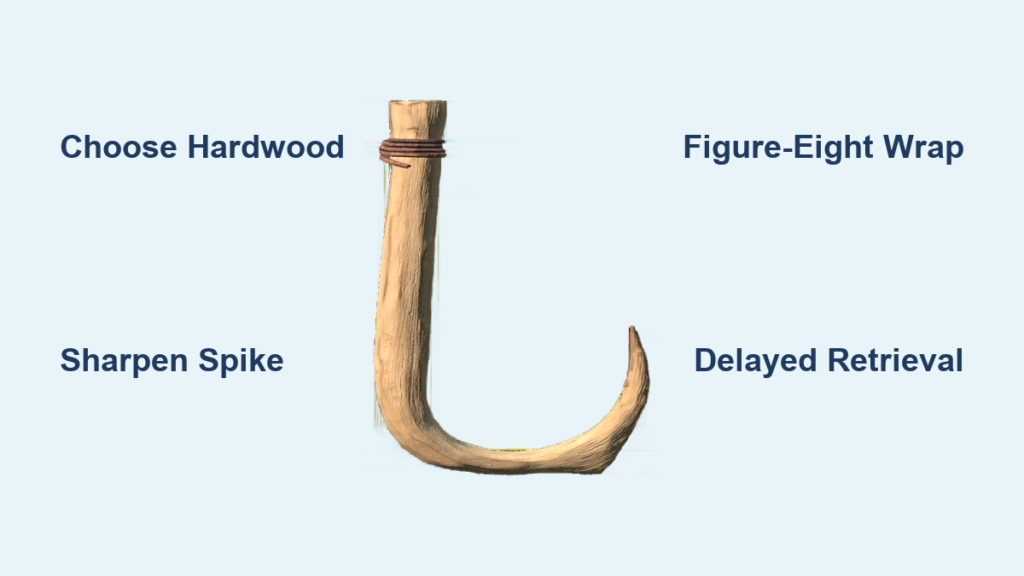
The composite wooden fish hook combines a carved wooden shank with a separate piercing element such as thorn, bone, or bamboo. It offers better control, higher strength, and improved hooking efficiency compared to pure wood designs.
Step-by-Step: Build It Right
Shape the Wooden Shank
Cut a two to three inch piece of hardwood. Flatten one side along its length using a knife. Narrow the flattened side to create a slight inward curve, which becomes the hook is bend. Taper the end where the spike will attach to form an angled base. Keep the opposite side rounded for strength. Leave extra length at the back to use as a handle while carving.
Attach the Spike Securely
Use one of two methods for secure attachment.
The figure-eight wrap provides the most secure binding. Lay the cord along the flattened side. Loop it over the shank tip and back under. Insert the spike through the loop. Begin a figure-eight wrap by going over the spike, then under, then over again. Wrap tightly until the base is fully covered. Wind cord back along the shank, tuck the end under last wraps, and pull tight. No glue is needed. Friction from tight wraps locks it in place.
The direct binding method is simpler. Pass the spike through the line eye. Wrap cord tightly around spike base and shank. Finish with a tucked end.
Optional: Apply pine resin before wrapping. It hardens and improves grip in wet conditions.
Add Line Attachment
Carve a small notch on top of the shank, just above the bend. Thread the fishing line through and tie off. This prevents slippage during retrieval.
Final Touches
Trim excess wood or cord. Smooth rough edges with sandstone. Resharpen the spike tip if dulled during construction.
Adjust Hook Gap for Target Species
Steeper angles create narrower gaps suited for small fish. Shallower angles create wider gaps for larger fish. Match hook size to expected prey. A one-inch spike on a two-inch shank handles bass, catfish, and carp up to ten pounds.
Alternative Wooden Hook Designs
Beyond the basics, several other designs offer unique advantages.
The carved wooden gut hook uses a single piece of hardwood tapered to a point. The line attaches via a notch or hole at the blunt end. Insert it vertically into bait. It rotates and lodges in the stomach when swallowed. This design appears in museum collections and is historically proven.
The spliced multi-prong hook binds two or more splinters at an angle. It can include animal tooth, claw, or nail as the piercing tip. This simulates barbs or multiple points and works well for snagging fish in low-visibility water.
Harden and Protect Your Wooden Hook
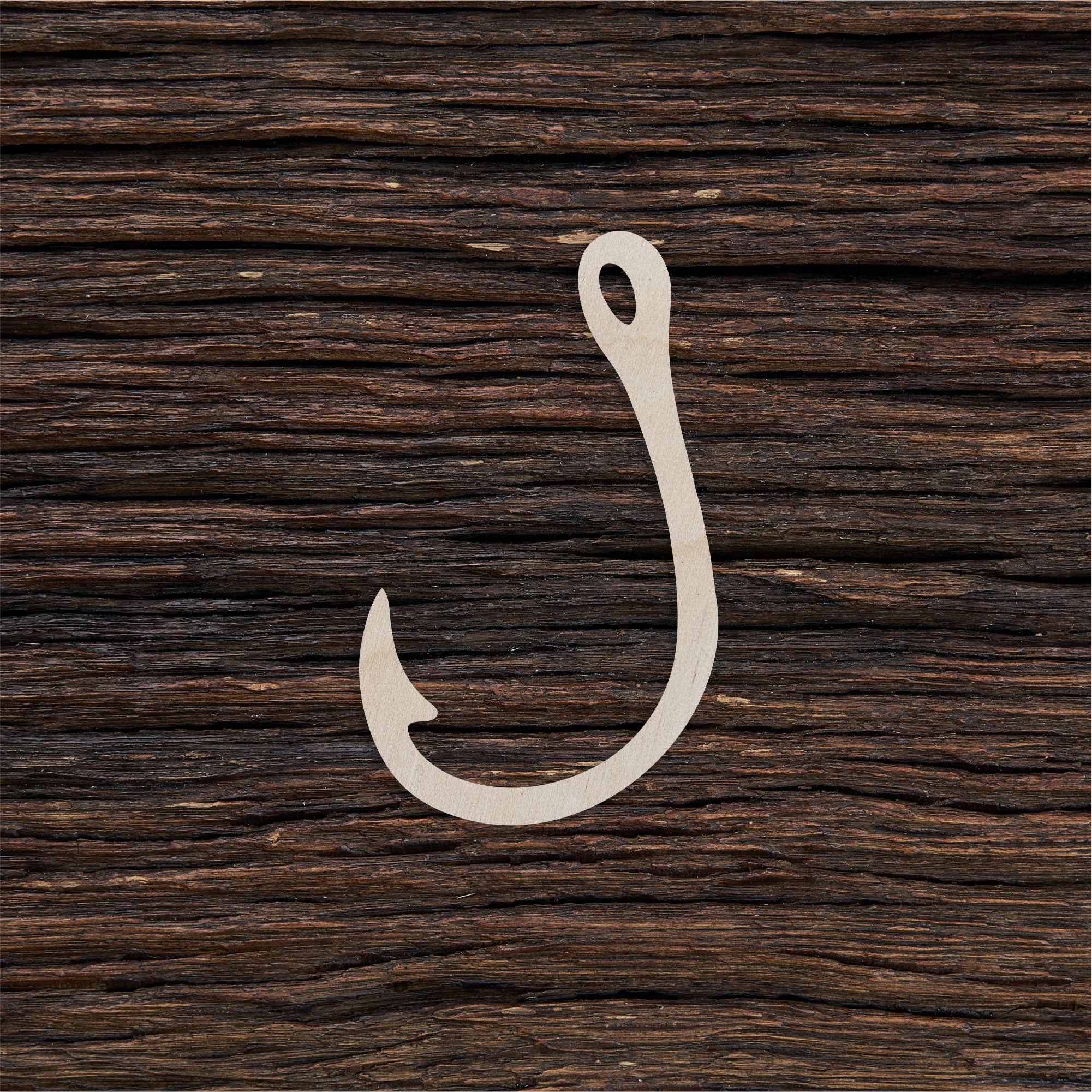
Raw wood weakens in water. Make your hook last longer with these finishing techniques.
Heat-Treat the Tip
Hold the tip in a flame for 10 to 15 seconds. Char the surface without burning through. Quench in water or oil to harden, similar to tempering steel. The result is a carbonized, sharper, more durable tip. Warning: Overheating weakens wood, so keep the process brief.
Seal Against Water
Coat with pine resin or tree pitch to prevent water absorption, reduce warping, and add slight buoyancy. Rub with animal fat as a natural preservative that keeps wood flexible. Reapply after each use.
Smooth for Performance
Polish surfaces with sandstone or bark to reduce drag in water and prevent line abrasion.
Bait and Fish Like a Primitive Angler
Even the best hook fails without proper technique. This is not modern fishing.
Choose the Right Bait
Earthworms are most effective because fish swallow them whole. Grubs or insects work well for small fish. Fish scraps or meat attract catfish and pike. Dough or plant matter works in still water with carp. Bait must fully conceal the hook with no exposed points.
Baiting by Design
For gorge hooks, position the spike parallel to bait length. For gut hooks, insert vertically. For composite hooks, hide the point inside the bait while leaving the shank exposed. Secure with light fiber if needed.
The Delayed Retrieval Technique
This technique is critical for success.
Cast into cover or drop-offs. When you feel a nibble, do NOT set the hook. Instead, let out 10 to 15 feet of line and wait 20 to 30 seconds for full ingestion. Begin slow retrieval. The hook rotates and lodges. Use a net or landing tool. Do not lift directly. Remove by tearing free. The hook is often destroyed during removal.
Fish must swallow the hook deep. Pulling too soon pulls it right out.
Know the Limits and Best Practices
Wooden hooks are not magic, but they work when nothing else does.
Strength and Real-World Limits
Well-built composite hooks have landed eight to ten pound fish. Failure points include loose wraps, weak wood, and poor spike attachment. These hooks are not reusable. Expect damage during removal.
Best Practices Summary
Oak, apple, hawthorn, and black thorn provide the best wood. The composite hook with figure-eight wrap is the top design. Bone or thorn outperforms carved wood as spike material. Use figure-eight wrap with pine resin for binding. Attach line via notch or hole, not just tied. Apply the delayed retrieval method of 20 to 30 seconds. Resharpen, re-wrap, or replace spikes for repairability.
Make multiple hooks in advance. Test them in non-emergency settings.
Compare Wooden Hooks to Modern Alternatives
Wooden gorge hooks are swallowed and rotate for delayed setting. Metal hooks snag the lip with immediate setting. Thorn hooks swallow and require delayed retrieval. Ring pull hooks snag the lip with immediate setting.
Wooden hooks are not reusable and cannot support catch-and-release. Metal and ring pull hooks are reusable and support catch-and-release. Wooden hooks offer moderate strength, while metal hooks provide high strength. The best use for wooden hooks is survival and subsistence fishing.
Wooden hooks are less efficient than metal, but when you have nothing, they are everything.
Frequently Asked Questions About Making a Fishing Hook Out of Wood
What is the best wood for making a wooden fishing hook?
Oak, apple wood, hawthorn, black thorn, and maple provide the best results. These dense hardwoods resist splitting, hold points well, and withstand the stress of landing fish. Avoid softwoods like pine, which splinter and fail under pressure.
How does a gorge hook differ from a modern fishing hook?
Modern J-hooks snag the fish is lip or jaw when you set the hook. Gorge hooks are designed to be swallowed completely. When you pull the line, the hook rotates sideways in the throat or stomach, locking in place. This requires the delayed retrieval technique rather than immediate hooksetting.
Can wooden hooks catch large fish?
Yes, well-built composite hooks with bone or thorn spikes have landed fish up to eight to ten pounds. Success depends on using appropriate hook size for the target species, proper binding technique, and correct fishing technique. Larger fish require thicker shanks and stronger cordage.
Why is delayed retrieval necessary with wooden hooks?
Wooden gorge hooks must be fully swallowed to work. If you set the hook immediately when you feel a bite, the fish will simply spit it out. Waiting 20 to 30 seconds allows the fish to swallow the hook deep enough that rotation locks it in place during retrieval.
Are wooden fishing hooks reusable?
Generally no. Most wooden hooks are destroyed or damaged when removing them from the fish is throat or gut. This is why making multiple hooks in advance is recommended. The design prioritizes catching the fish over repeated use, which makes sense for survival and subsistence situations.
Final Thoughts on Mastering Wooden Hook Craft
Knowing how to make a fishing hook out of wood is not a bushcraft party trick. It is a lifeline. In a survival situation, this skill can turn a hungry day into a meal. While it demands patience and adaptation, especially the counterintuitive delayed retrieval technique, it is rooted in thousands of years of human ingenuity.
Start by practicing with scrap wood and paracord. Try the composite design with a blackthorn spike and figure-eight wrap. Bait with a worm, cast into a quiet pool, and wait. When you feel that tug and land your first fish with a handmade wooden hook, you will understand something deeper. You do not need modern gear to survive.
Carve one. Test one. Keep one in your survival kit. Because one day, it might be the only hook you have.