You’ve felt the jolt. After hours of waiting, a heavy thud ripples through your rod. You pause, let the fish take the bait, then set the hook. But the line goes limp. When you reel in, your bait is half-gone and the hook is untouched. This is the classic short strike, and it’s why learning how to make a double hook fishing leader is essential for serious anglers targeting trophy fish.
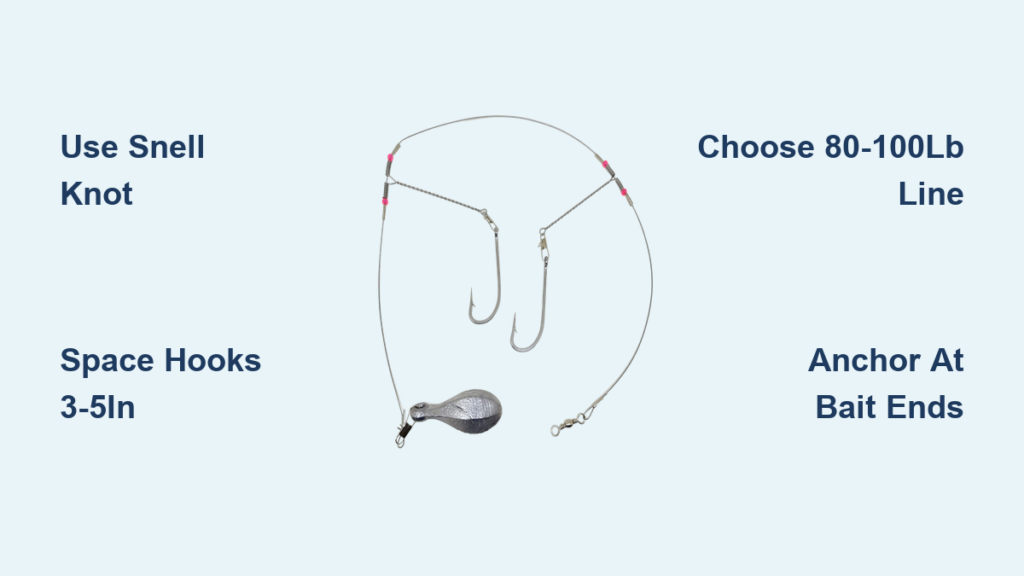
A double hook leader, also called a tandem or stinger rig, dramatically increases your hook-up ratio when using large baits like cut herring, carp, or shad. By placing a second hook along the length of your bait, you cover both the head and tail, eliminating dead zones where fish can bite without getting hooked. This guide walks you through every step, from knot selection and hook spacing to rig integration and real-world tactics.
Why Use a Double Hook Leader
The double hook leader is not about doubling your bait. It is about maximizing coverage on one large piece. When fishing with baits over six inches, a single hook leaves too much vulnerability.
Stop Short Strikes for Good
Predatory fish often test large baits before committing. A flathead catfish might nip the tail of a cut skipjack, disabling it without ever touching the head where the hook sits. With only one hook, you miss the strike entirely.
A second trailing stinger hook catches these cautious bites. Whether the fish attacks mid-body or swallows from the tail, at least one hook has a chance to set. This simple change can double your success rate on short-striking fish.
Improve Bait Stability and Presentation
Large cut baits are heavy and prone to twisting or tearing during casting or in strong current. A single hook can pull through soft tissue, leaving your bait mangled and your hook exposed.
Two snelled hooks anchor the bait at both ends, keeping it aligned with the current and preventing it from spinning or bunching. This creates a more natural, lifelike presentation and keeps both hook points where they need to be: exposed and ready.
Essential Gear for Tandem Leaders
Before tying, gather the right components. This rig demands heavy-duty materials built for big fish and tough conditions.
Choose the Right Leader Line
Use 80 to 100 pound test monofilament or fluorocarbon. Here is how they compare:
• Visibility: Monofilament offers low visibility while fluorocarbon is near-invisible
• Stretch: Monofilament provides high stretch for shock absorption while fluorocarbon offers low stretch for better sensitivity
• Abrasion Resistance: Monofilament rates moderate while fluorocarbon rates high
• Knot Strength: Monofilament is excellent while fluorocarbon requires careful tying
• Cost: Monofilament is budget-friendly while fluorocarbon is premium priced
Monofilament is ideal for most catfishing because its stretch absorbs violent runs. Fluorocarbon excels in clear water or around rocks and timber where stealth and durability matter.
Select the Correct Hooks
You have two main options: circle hooks and J-hooks.
• Circle Hooks (Recommended): These are self-setting and fish-friendly. They rotate into the corner of the jaw when pulled, reducing gut-hooking. Both hooks should be snelled to maintain alignment.
• J-Hooks: These require a manual hookset. Some anglers use a J-hook as the stinger for better penetration on tail bites.
Common sizes range from 6/0 to 8/0 depending on bait size and target species.
Pro Tip: Use slightly smaller stinger hooks (for example, 6/0 top, 5/0 bottom) for better tail coverage without overloading the bait.
Master the Snell Knot
The snell knot is the foundation of a reliable double hook leader. Unlike standard eye knots, the snell wraps around the hook shank, aligning the line with the hook’s natural pull direction.
Why the Snell Knot Wins
• It ensures perfect line-to-shank alignment
• It maximizes hook rotation for circle hooks
• It prevents slippage under heavy load
• It allows multiple hooks on one line
Never tie circle hooks with a Palomar knot because it defeats their self-setting design.
How to Tie a Snell Knot
- Thread the line through the hook eye from front to back, point side first
- Lay the tag end along the shank and form a loop
- Wrap the tag end around the shank and standing line 7 to 10 times
- Pass the tag end back through the loop near the eye
- Pull tight, wetting the knot first to reduce friction heat
- Trim excess close to the knot
Repeat this process for both hooks. Always snell, never eye-tie, in a tandem rig.
Build Your Double Hook Leader

Follow these steps to create a battle-ready tandem leader. Practice at home so you can tie quickly on the water.
Cut the Leader Line
Start with 30 inches of 80 to 100 pound test line. This gives enough length for knots and rig attachment. You can trim later if needed.
Snell the Bottom Hook
This is your stinger hook, the trailing point.
• Thread the line through the eye from the front
• Snell it using 7 to 10 wraps
• Seat the knot firmly against the eye
• Trim the tag end
Slide on the Top Hook
Take your second hook and slide it onto the line. Do not tie it yet. Thread from front to back so the hook lies naturally when tension is applied.
Set Proper Hook Spacing
Slide the top hook down until it is 3 to 5 inches from the bottom hook. Match spacing to bait size:
• 4 to 6 inch bait requires 2 to 3 inches apart
• 8 to 12 inch bait requires 4 to 5 inches apart
• Live bait like a sucker requires top hook through lips and bottom near dorsal fin
Hold the top hook in place. It is now ready to snell.
Snell the Top Hook
With the bottom hook already tied, use the main line, not the tag, to snell the top hook.
• Wrap 7 to 10 times around shank and line
• Pass the end through the loop and pull tight
• Wet the knot before cinching
Now both hooks are securely snelled and spaced.
Attach a Barrel Swivel
On the open end of the leader, tie a heavy-duty barrel swivel using a Palomar or Improved Clinch knot. This connects to your main line and prevents line twist.
Always wet knots before tightening, especially with heavy monofilament.
Optimize Hook Spacing and Bait Rigging
Spacing is not arbitrary. It is dictated by your bait. Misplaced hooks reduce effectiveness or increase snags.
Match Hooks to Bait Type
| Bait Size | Hook Spacing | Top Hook Placement | Bottom Hook Placement |
|---|---|---|---|
| 4 to 6 inch cut | 2 to 3 inches | Through head/bone | Mid-body |
| 8 to 12 inch cut | 4 to 5 inches | Near head | Tail section |
| 10 inch live | 4 to 5 inches | Lips/nose | Near tail fin |
Bait Rigging Tips
• Anchor the top hook in bone or cartilage because it handles casting stress
• Expose hook points because buried points cannot rotate or catch
• Keep line snug between hooks because slack causes tangles or wraps
• Use fresh, firm bait because soft or torn bait increases failure risk
Expert Note: For live bait, lightly pin the stinger hook through the tail muscle without restricting movement.
Avoid Common Tandem Rig Mistakes
Even seasoned anglers make errors that cost fish. Watch for these pitfalls.
Threading Hooks Backward
Always thread line from front to back through the eye. Backward threading causes the hook to tilt inward, reducing hookset efficiency by up to 70 percent.
Correct: Line enters eye from point side.
Wrong: Line enters from shank side.
Using Light Leader Line
Tying two 7/0 hooks on 20 to 30 pound test is asking for disaster. The bait’s weight alone can snap light line during casting. Stick with 80 to 100 pound test.
Leaving Slack Between Hooks
Loose line between hooks can wrap around the bait or other hook, creating a tangle. Keep it tight and straight, letting the bait’s shape provide natural curve.
Skipping Knot Inspection
A messy snell knot with overlapping wraps will fail under pressure. If it looks uneven, cut it and re-tie. One failed knot can cost you a lifetime fish.
Connect to Your Fishing Rig

A double hook leader is a terminal component. You need a full rig to deploy it effectively.
Use the Santee Cooper Rig
This rig is ideal for catfishing in snag-prone areas.
• Main line to slip sinker to bead to barrel swivel
• Attach leader to swivel
• Add a peg float 6 inches above top hook
• Float lifts bait off bottom, reducing snags
Best for rivers with debris, muddy bottoms, or heavy cover.
Try the Slip Sinker Carolina Rig
This is simple and effective in current.
• Main line to slip sinker to bead to swivel
• Attach leader to swivel
• No float, bait rests on bottom
Best for strong current, deep holes, or when fish are holding tight to structure.
Deploy the Three-Way Rig
Use this for deep or fast water.
• Use a three-way swivel
• Main line to top eye
• Weight on dropper line 6 to 12 inches
• Leader on third eye
This keeps bait suspended above the riverbed, ideal for offshore catfish or saltwater species.
Store Pre-Tied Leaders for Fast Changes
Tying on the water wastes time and increases frustration. Pre-tie multiple leaders before your trip.
How to Organize Leaders
• Make 5 to 10 leaders with different spacing like 2 inches, 4 inches, and 6 inches
• Label each by bait size or rig type
• Store in a leader wallet or ziplock bag with dividers
• Keep in a dry, shaded compartment
Pro Tip: Attach a small tag with hook size and spacing using a permanent marker.
Having ready-to-go leaders means you can swap in seconds after a break-off or when switching bait, keeping your line in the water longer.
Know When NOT to Use Two Hooks
The double hook rig is powerful but not always the best choice.
Avoid in Heavy Snag Zones
Two hooks double your snag risk in submerged timber, rock piles, or brush. In these areas, a single hook with well-placed bait may be more effective.
Skip for Small Bait
Using two hooks on a 3-inch chunk of bait or a worm is overkill. It looks unnatural and can scare off smaller fish like channel cats.
Check Local Regulations
Some states limit the number of hooks per line or require minimum spacing between hooks. Always verify rules before fishing.
Example: Virginia allows two hooks for catfishing but only if spaced appropriately and used with cut bait.
Practice for Real-World Success
Tying a perfect snell knot in daylight is easy. Doing it at 3 a.m. with cold, wet hands is another story.
Build Muscle Memory
• Buy cheap 80 pound test and a pack of practice hooks
• Tie 10 to 20 leaders at home
• Time yourself, aiming for under 3 minutes per rig
• Practice with gloves on to simulate cold conditions
Goal: Tie the entire rig without looking.
The more you practice, the faster and more reliable your knots become, and when a trophy bites, that preparation pays off.
Final Tips for Maximum Effectiveness
• Use high-quality hooks because cheap hooks bend or break under pressure
• Carry long-nose pliers because two hooks mean more extraction work during release
• Rinse leaders after saltwater use because fluorocarbon and swivels degrade faster when not cleaned
• Inspect leaders before each use, checking for nicks, abrasions, or weakened knots
Key Takeaways for Making a Double Hook Fishing Leader
Learning how to make a double hook fishing leader is one of the most impactful upgrades an angler can make. It solves the frustrating problem of short strikes, improves bait presentation, and dramatically increases your odds of landing trophy fish. By using heavy-duty line, mastering the snell knot, spacing hooks correctly, and integrating the leader into the right rig, you eliminate guesswork and maximize efficiency. Whether you are fishing for blue cats in a deep river or targeting saltwater brutes, this simple tandem setup gives you the edge. Pre-tie your leaders, practice your knots, and hit the water ready. The next time that heavy thud comes, you will not just feel it. You will land it.
Frequently Asked Questions About Double Hook Fishing Leaders
What is the best knot for a double hook fishing leader?
The snell knot is essential. It aligns the line with the hook shank, ensuring proper rotation, which is especially critical for circle hooks.
Can I use different sized hooks on the same leader?
Yes. Many anglers use a larger top hook like 8/0 and a smaller stinger like 5/0 or 6/0 for better tail coverage and easier penetration.
How far apart should the hooks be placed?
Three to 5 inches is standard for large cut bait. Always match spacing to your actual bait size by measuring before tying.
Does a double hook rig harm fish during release?
Not if using circle hooks. They typically catch the jaw. But always carry long-nose pliers to safely remove both hooks and reduce stress on the fish.
Can I use this rig for species other than catfish?
Absolutely. The tandem rig works for stripers, luderick, cobia, and other predators that short-strike large baits.
What leader material works best for double hook rigs?
Eighty to 100 pound test monofilament or fluorocarbon works best. Monofilament offers stretch for shock absorption while fluorocarbon provides invisibility and abrasion resistance.